Main line
Drain Line Repair in Greenville, SC
Drain line repair, replacement, and maintenance with camera inspection and jetting.
Signs the line itself is failing
A drain line carries wastewater from every toilet, sink, shower, tub and appliance to the sewer connection or municipal system. When that path narrows or breaks, the first symptom is rarely dramatic. It shows up as a slow drain, a gurgle from the tub when the washer empties, or a toilet that will not flush with its usual force. Because those signs are easy to put off, a failing line often runs for months before it becomes an emergency.
The pattern is what separates a line problem from a clog. One slow sink is usually local. Multiple fixtures draining slowly at once, recurring clogs in the same line, sewage odors inside or near the building, and backups after heavy rain or when an appliance runs all point to the line itself. Outside, a patch of unusually green or soggy yard can mean a buried line is leaking into the soil above it.
Upstate yards add their own causes. Tree roots find the joints in older clay and cast iron lines and grow into them, and Greenville clay soil settles and shifts around pipe over the years. If any of those signs sound familiar, call (864) 436-3006 before the backup arrives. Catching it early costs less than a flooded floor, and the free on-the-spot estimate means finding out is not a gamble.
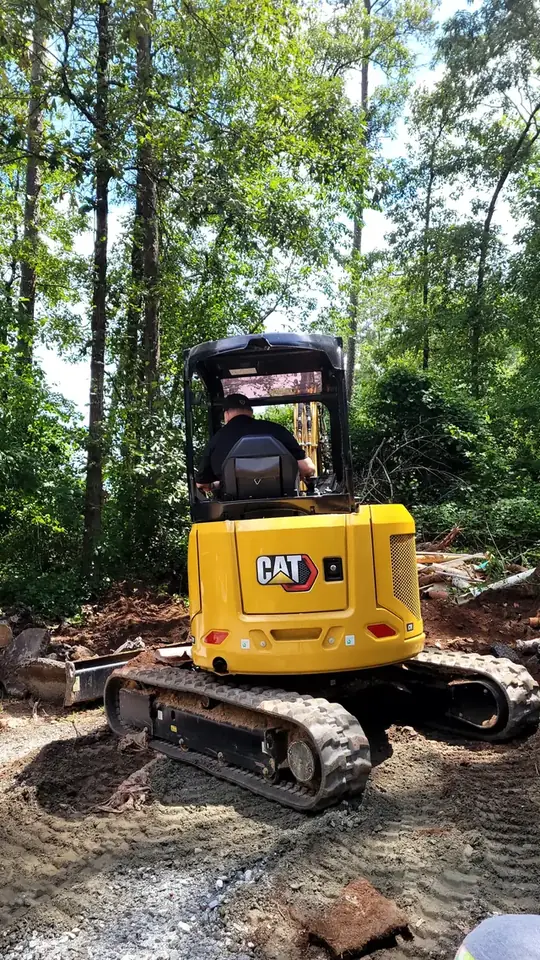
Mini excavator opening ground beside a house for a buried line
Camera inspection before anyone digs
The blockage is not always where you can see it, and digging a trench to look is the most expensive way to find out. We run a video camera pipe inspection first. A small camera travels through the line and shows real-time footage inside your drain system, so we can locate clogs, cracks, root intrusion, or a bellied section, a low spot where the pipe has sagged and holds water.
That footage turns a guess into a decision. A bellied section sits full of standing water and collects waste, so it keeps clogging no matter how often it is cleared. A crack lets soil and roots in. A clean pipe with a single blockage tells us a cleaning is all the line needs. You see what we see and we point to where it is on the screen, then locate the spot so any excavation is limited to where the line has actually failed.
Finding the source of drainage issues this way also keeps repairs honest. We are not recommending replacement because a line is old. We recommend it when the footage shows the pipe cannot do its job. Request service and we will explain what the camera found, what it means, and what the options are.
Jetting, repair or replacement
Once we know what is in the line, the choice is usually among three paths. If the pipe is sound but coated or partly blocked, high-pressure water jetting scours the walls clean and restores the full bore. Electric drain cleaning handles the softer stoppages and early root growth. When the camera shows a localized crack, a separated joint or a collapsed section, we repair that stretch and leave the healthy pipe in place.
Replacement is the last answer, not the first. When a long run is cracked, bellied or full of root damage, it makes sense to replace it properly. That can involve excavation for buried line access, which is what the mini excavator in the photo on this page is doing: opening the ground beside a house to get at a line that cannot be fixed from inside. We keep the dig as small as the footage allows.
Whichever path fits, you get a free on-the-spot estimate before any work begins, and our labor is backed by a one-year warranty. Steve Pillon has handled Upstate drain lines since 2010. When Kelly Phillips had a job that turned out to be more time consuming and difficult than expected, the team stayed with it until the plumbing worked again. That is the standard we hold ourselves to.
“We ended up having an issue that was more time consuming and difficult, but Steve and his team were great and got our plumbing fixed.” Kelly Phillips, Google review.