A Burst Pipe in Your House: The First Ten Minutes
The order you act in matters more than how fast you clean up, and most of it can be done before a plumber arrives.
October 14, 2026 · 4 min read
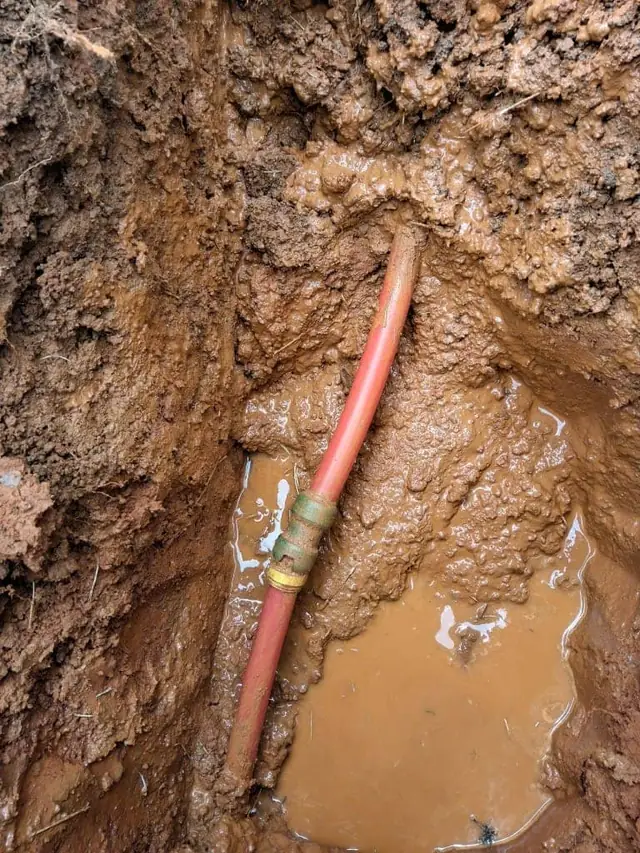
A burst pipe does not always announce itself with a spray. Sometimes it is a hiss inside a wall, a steady roar from the crawlspace, or a stain spreading across a ceiling that was dry an hour ago. However you find it, the first ten minutes decide whether you are drying out one room or replacing flooring in three. Work in the order below, and leave the mopping until the water is off.
Minute one: shut the water off at the main
The main shutoff sits where the water line enters the house. In the Upstate that is often on a basement or crawlspace wall, in a garage, in a utility closet near the water heater, or in a box near the street. Many homes also have a valve at the meter, but that one belongs to the utility, so look for the valve on your side of it first. If you have never located yours, do it this week, on a calm day, and tie a bright tag to it.
Two styles of valve are common. A lever handle is a ball valve, and a quarter turn closes it when the lever sits crosswise to the pipe. A round wheel handle is a gate valve, and it takes several full turns clockwise. Older gate valves can be stiff or may not seal completely. If the wheel will not turn, do not lean on it with a pipe wrench until something snaps. Close what you can, and make the call.
With the main closed, open one cold tap on the lowest level of the house and one upstairs. The pipes still hold water above the break, and opening taps lets that water drain into a sink instead of into your wall.
Minute three: protect the water heater and the electrical
A tank water heater that loses its supply while the burner or elements are running can be damaged. If the break is large and the main is off, turn the heater off as well. On an electric unit, switch off its breaker. On a gas unit, turn the gas control to the off position marked on the valve. You do not need to drain the tank, and you should not try unless you know how.
Water and electricity deserve more caution than the water itself. If water is dripping through a ceiling light, pooling around outlets, or running toward the panel, do not stand in a wet area to flip a breaker. Cut power to the affected area from a dry spot. If the panel is wet or you cannot reach it dry, stay clear and call the electric utility or an electrician. Furniture and flooring can be replaced; you cannot.
Minutes five to eight: contain the water and document it
Now deal with the water that is already out. Lift rugs, electronics and anything that wicks moisture off the floor. Lay towels across doorways to keep it from spreading, and use a wet vacuum or buckets if you have them. Stay out from under a ceiling that is sagging or bulging. Water trapped in drywall is heavy, and it can come down all at once.
Before you move too much, take photos and short video. Insurance adjusters want to see the damage as it was, not as it looked after you cleaned. Wide shots show the room, and close shots show the detail. Say the date and time out loud on the video, and write down when you found the break and when you closed the main.
- The failed pipe or fitting, in a wide shot and a close one
- Every wet wall, ceiling and floor area, with a tape measure or a familiar object for scale
- Damaged furniture, flooring, electronics and stored boxes
- The shutoff valve you closed
- Older stains or damage that were there before today, so they are not confused with new loss
If you can safely keep the section of pipe that failed, set it aside. A split in a copper line or a cracked fitting tells the plumber and the adjuster something about what happened, and it is gone for good once the repair is done.
Minute ten: decide who to call
Call a plumber first if water is still moving, if you could not find the source, or if the main would not close. A claim line can wait ten minutes, and a running pipe cannot. Once the leak is stopped, call your insurance carrier and ask what they need from you. All About Plumbing SC works with homeowners insurance claims, and a clear written description of what was found and what was repaired makes the adjuster's job easier.
Some situations call for the emergency line without any further troubleshooting. These include a main you cannot shut off, water near the electrical panel, a leak inside a wall or ceiling you cannot see into, a wet patch in the yard with a drop in water pressure, sewage coming up through a drain, and a water heater tank that is itself the source. Give the dispatcher your address, what you can see, and where your main shutoff is. Estimates are free and done on the spot, and nothing starts until you approve it.
Two things to avoid while you wait. Do not cut into walls or ceilings to find the leak, because opening the wrong spot adds repair work and rarely finds the break faster. And keep the main off until the repair is made, unless your plumber tells you they have isolated the broken section and the rest of the house can safely have water again.
If you are standing in water right now, the 24/7 emergency line is (864) 436-3006.
All About Plumbing SC, (864) 436-3006
Call (864) 436-3006More articles
How to Flush a Tank Water Heater, and When to Leave It Alone
Sediment shortens the life of a tank heater. Flushing helps, as long as the unit is in shape to be flushed.
Sink Clog or Failing Drain Line? How to Tell the Difference
One slow sink is a clog. Several slow fixtures at once usually mean the line they all share.