Sink Clog or Failing Drain Line? How to Tell the Difference
One slow sink is a clog. Several slow fixtures at once usually mean the line they all share.
October 14, 2026 · 4 min read
A single slow drain is usually a local problem: hair in the shower, grease in the kitchen sink, a toy in the toilet. You clear it, and it stays clear. A drain line problem behaves differently. The trouble shows up in more than one place, it keeps coming back, and a plunger or a bottle of drain cleaner gives only a short break. Telling the two apart saves you from repeating a fix that was never going to work.
Start with how many fixtures are affected
Every fixture in your house drains into a branch, and the branches join the main drain line that leaves the house toward the street or the septic tank. A clog in one fixture's own pipe affects only that fixture. A restriction in the main line affects everything that connects downstream of it. So walk through the house and notice what else is slow. If the tub is slow and the guest bathroom sink is fine, the problem is local. If the tub, the washing machine standpipe and the kitchen sink are all sluggish, the shared line is the suspect.
Pay attention to the lowest fixtures. A basement floor drain or a first-floor tub is the first place a backed-up main line shows itself, because water seeks the lowest opening. If the floor drain bubbles or gurgles when you run the washing machine upstairs, the main line is not carrying water away as it should.
Sounds, smells and the weak flush
Gurgling is air being pushed or pulled through water that is struggling to drain. When one fixture drains and another nearby gurgles, the water is meeting resistance in the line. A toilet that flushes weakly, or that makes a bubble in the bowl when the sink empties, points the same way. The toilet is closest to the main line of any fixture in the house, so it often tells you first.
Odors matter too. A sewer smell that comes and goes, especially near a floor drain or in a bathroom that is rarely used, can come from a dry trap, which is easy to fix with a little water. A sewer smell that persists, or that comes with slow drainage, points to a line that is holding waste rather than carrying it off.
- Slow drains in more than one fixture at the same time
- Gurgling from a drain when you run water somewhere else
- Persistent sewer odors inside or near the yard
- A toilet that flushes weakly or bubbles when another fixture drains
- A clog that returns within days or weeks of being cleared
Why drain lines fail in the first place
Older homes in the Upstate often have drain lines that have been in the ground for decades, and the line itself changes over time. Roots find small openings at joints and grow into the pipe looking for moisture. Sections can sag, creating a low spot where waste settles. Older pipe can crack, collapse or separate at a joint. Grease and wipes build up on the pipe wall. Each of these can look the same from inside the house, which is why a guess at the cause is a poor basis for a repair.
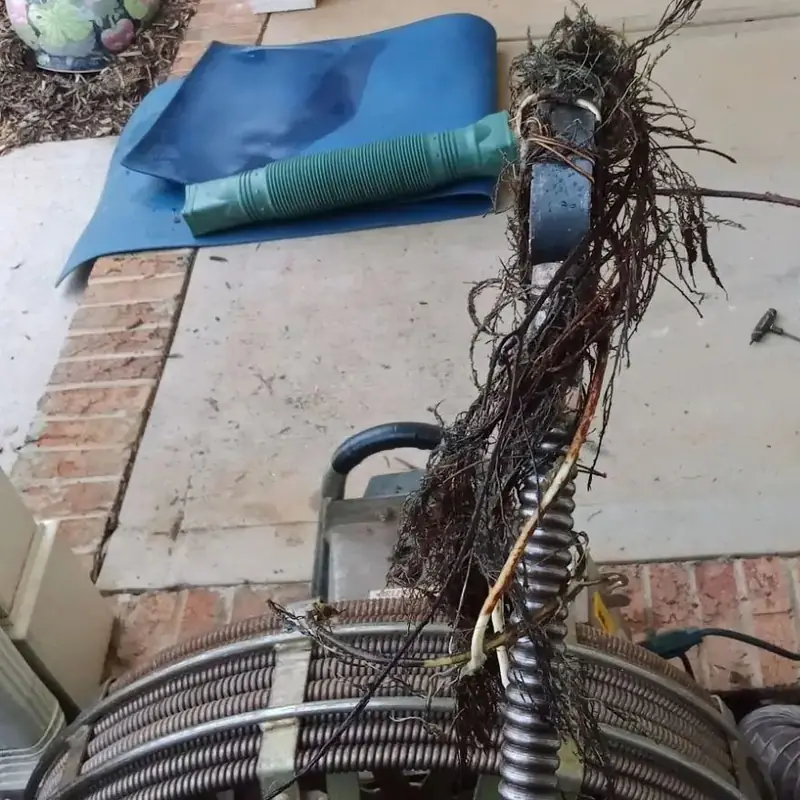
The photo with this article shows what a cleaning cable looks like after it has been through a root-bound line. Cutting the roots restores flow for a while. But if you only cut and never look, you do not know whether the pipe is merely root-bound or damaged underneath, and roots will return to the same opening.
Why a camera inspection comes before digging
The expensive mistake with a drain line is digging before you know what you are digging for. A small camera on a flexible cable can travel through the line and show exactly what is there: roots, a belly where water pools, a cracked section, a joint that has shifted, or a simple grease blockage. It also shows how far from the cleanout the problem sits, so any repair can be limited to the section that actually needs it.
Sometimes the camera shows that a line is intact and only needs to be cleaned, and high-pressure jetting can clear buildup from the pipe wall that a cable alone leaves behind. Sometimes it shows a failed section that does need to be excavated and replaced. Either way, you decide with a picture of the pipe in front of you, and you are not paying to open the yard on a hunch.
If a line is cleared and the problem is likely to return, ask about maintenance between professional cleanings. A biological drain maintainer can help keep organic buildup in check in some lines, though it does not repair a cracked pipe or remove roots, and it is a supplement to cleaning, not a replacement for it.
What you can do before anyone arrives
Stop running water that you do not need to run. Every load of laundry and every shower adds to a line that cannot carry it, and a full line can back up into the lowest fixture in the house. If water is coming up out of a floor drain or tub, keep the washing machine and dishwasher off until the line is cleared. Avoid repeated rounds of chemical drain cleaner in a line that serves the whole house. It rarely clears a main line, and the standing chemical is unpleasant for whoever has to open the pipe afterward.
For drain line cleaning, camera inspection and repair, see /services/drain-lines or call (864) 436-3006.
All About Plumbing SC, (864) 436-3006
Call (864) 436-3006More articles
A Burst Pipe in Your House: The First Ten Minutes
The order you act in matters more than how fast you clean up, and most of it can be done before a plumber arrives.
How to Flush a Tank Water Heater, and When to Leave It Alone
Sediment shortens the life of a tank heater. Flushing helps, as long as the unit is in shape to be flushed.